

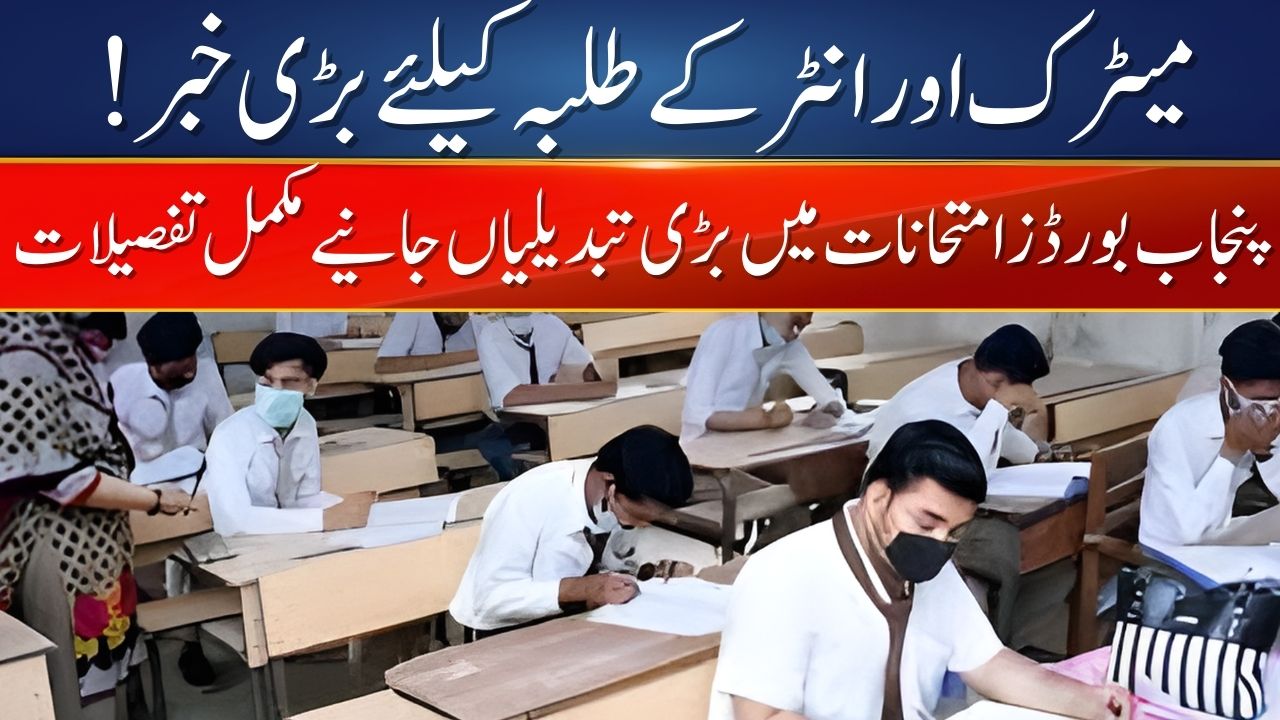
The Punjab Boards Committee of Chairmen (PBCC) and the Higher Education Department have rolled out sweeping reforms for the 2026 examination cycle. These changes represent the most significant overhaul of the provincial education system in decades, moving away from “marks-focused” rote learning toward a modernized evaluation framework.
The New 10-Point Grading System
Punjab has officially ditched the old 7-point (A-1, A, B…) system in favor of an international-standard 10-point scale. This change is designed to curb unhealthy competition and grade inflation.
| Percentage Range | Grade | Description |
| 96% – 100% | A++ | Extraordinary |
| 91% – 95% | A+ | Exceptional |
| 86% – 90% | A | Outstanding |
| 81% – 85% | B++ | Excellent |
| 76% – 80% | B+ | Very Good |
| 71% – 75% | B | Good |
| Below 40% | U | Ungraded (Unsatisfactory) |
Higher Passing Threshold (40%)
In a move to improve academic quality, the minimum marks required to pass a subject have been raised:
- Previous Passing Marks: 33%
- New Passing Marks (2026): 40%
- The “U” Grade: Students scoring below 40% will no longer be labeled as “Fail.” Instead, they will receive a “U” (Ungraded) or “Unsatisfactory” status. These students will be eligible to re-sit the exams to improve their scores.
Mandatory Biometric Verification
To eliminate cheating and the use of “impersonators” (fake candidates), the 2026 exams will be the first in Punjab’s history to use digital attendance.
- Biometric Entry: Candidates for Class 9 and Class 11 must provide thumb impressions during registration.
- Verification at Centers: These impressions will be verified at the entrance of the examination hall to ensure only the registered student is appearing.
Digital Paper Marking (E-Marking)
Human error in totaling and marking is being phased out through automation:
- Scanning: All answer sheets will now be scanned and uploaded to a secure portal.
- Computer Marking: Examiners will mark the scanned copies on computer screens.
- Accuracy: This system automatically totals the marks, preventing the common “totaling mistakes” that previously required manual re-counting applications.
Revamped Practical Exams & Monitoring
Practical exams for science subjects are no longer just a “formality”:
- Standardized Criteria: New uniform marking rubrics have been introduced for lab work.
- CCTV Surveillance: It is now mandatory for all laboratories to have CCTV cameras installed to monitor practical exams in real-time.
- External Oversight: A larger number of external examiners are being deployed to prevent local school influence on practical grades.
Important Dates for 2026
- Matric (SSC) Exams: Scheduled to begin around March 24, 2026 (adjusted to take place after Ramadan and Eid).
- Inter (HSSC) Exams: Class 12 exams begin on May 5, 2026, followed by Class 11 on May 24, 2026.
Note: The 10-point grading system is being implemented in phases. In 2026, it applies to Class 9 and Class 11. Students currently in Class 10 and Class 12 will still follow the old marking system for their final results this year.